 |
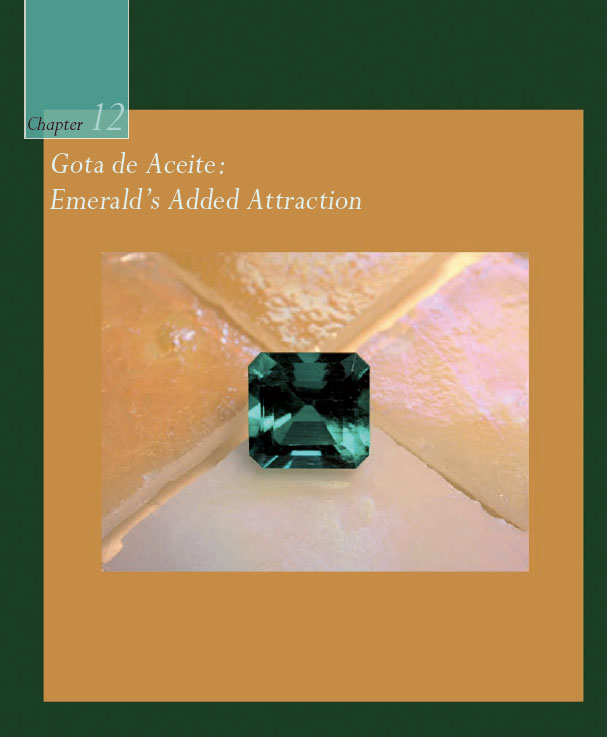
Left: The transparent roiled texture in this 4.68 ct. emerald |
Table of Contents More Sample Chapters
A sample chapter from Emeralds, A Passionate Guide.
The Colombian novelist Gabriel García Márquez wrote about love and magic in the classic novel One Hundred Years of Solitude. It is set in the fictional 1840s Colombian town of Macondo, situated in the verdant, semi-tropical jungle of the Andes Mountains, amidst the lushness and decay that is the essence of jungle life. The circus has just arrived in Macondo, as it does every year. The circus leader is Melquíades, a gypsy. Melquíades has brought with him many wonders of nature with which to astound the townspeople, including ice, flying carpets and a telescope. The curious brown-skinned circus leader visits his old friend Aureliano Buendía, and before leaving again, gives him a sextant, a gift that is respectfully accepted. One year passes, and Melquíades returns to Macondo with the circus. Aureliano Buendía seeks him out and reverently returns the sextant to his old friend. He exclaims, “Melquíades, the world is round. Like an orange!”
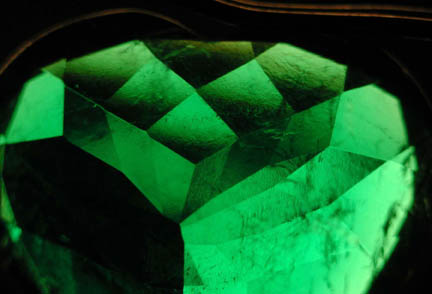
| [Fig. 1] A 9.20 ct. heart-shaped emerald. In the six upper facets a wavy, softening effect adds texture to the color and clarity expressed by this emerald. |
This scene captures the fascination and wonder that accompanies the discovery of new knowledge. This is exactly the proper use of science: to lead us to amazement of Nature’s creation and to experience a sense of wonder.
 |
Gota de Aceite
There is no better place to rediscover wonder than in a remarkable phenomenon that occurs inside the finest emeralds. That phenomenon is called gota de aceite (Spanish for “drop of oil,” pronounced “go-tuh day ah-say-tay”). A velvety interruption of the light passing through the emerald, the effect is prized by connoisseurs in the same way they value the velvety texture of a Kashmir sapphire. In both cases, the color of the stone is softened and the internal reflections are spread by numerous microscopic inclusions, reducing extinction and giving a liquid, velvety texture. Gota de aceite is associated with the Colombian emerald, and even in Colombian stones it is visible in only one in a thousand, mainly of fine quality. In six years of informal study of this phenomenon, I have only detected it rarely, personally viewing about 18 good examples, 20 moderate examples and 50 that were muted or indistinct.
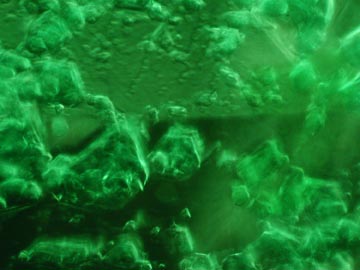 |
| [Fig. 2] Angular growth structures, photographed at 30x magnification, are typical of the gota de aceite phenomenon. |
The term gota de aceite is also known as the “butterfly wing effect” (efecto aleta de mariposa). Transparent irregularities in the internal crystal seem to be the result of changing and unstable conditions during emerald crystallization. These conditions give rise to both raised hexagonal terminations as well as etched geometric depressions. After their formation, these growth structures are overgrown with more emerald. The growth structure and patterns thus formed (Figure 2) are transparent and diffuse the light within the faceted emerald in a manner reminiscent of a drop of thick oil, hence the name. Since growth structures cause the effect, there is no reason that it could not be found in emeralds from localities outside of Colombia.
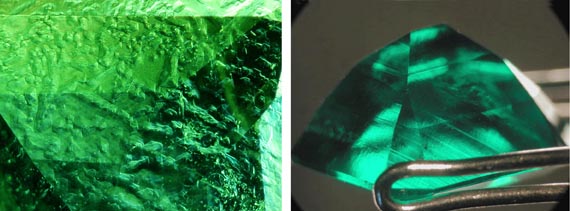
This phenomenon was also referred to as calcite precipitation (Figure 5). It was thought to be caused by a temporary lull in the crystallization process of the emerald, allowing small grains of calcite to form that were later overgrown with emerald. The calcite theory is losing out to another explanation of gota de aceite. Close microscopic examination indicates the presence of growth structures instead of calcite, according to researcher John Koivula. He points out that the forms (Figure 3) appear three-dimensional when viewed perpendicular to the plane of their formation, but when the stone is turned sideways, there is no space for them; they look flat. Also, no evidence of calcite was seen, either by microscopic examination or Raman spectroscopy.
| [ Fig. 3 ] The growth structures that cause gota de aceite can be somewhat difficult to see. The photo on the left reveals the angular or hexagonal growth features seen when looking down the c-axis. On the right, the same emerald is shown perpendicular to the c-axis, which reveals the typically narrow bands of columnar structures associated with this phenomenon. |
 |
In the gota de aceite effect, the etching and regrowth structures form in a plane perpendicular to the c-axis. If the emerald cutter positions this plane roughly parallel to the table of the faceted stone, it will be seen and appreciated by the viewer, increasing the emerald’s value and allure. Sadly, the effect gets wasted when the emerald’s owners and cutters do not recognize the effect and position the zone of gota de aceite to one side or perpendicular to the stone’s table. The difficulty of seeing it in the rough, along with the lack of understanding about it, are other reasons for the great rarity of gota de aceite emeralds in the market.
Researcher and author John Sinkankas noted that beryl crystals can often have many sub-individuals included within. Since these grow along with the original crystal, they are oriented to the c-axis, as in Figure 4.
Confusion of Nomenclature
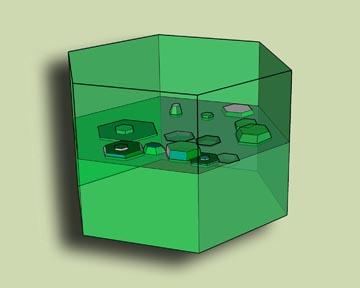 |
[ Fig. 4 ] |
Only among connoisseurs is this phenomenon understood. In Colombia, only experienced dealers recognize the butterfly wing effect; others overlook it. Nowadays, in Europe and the United States, the expression gota de aceite is often used to describe any fine emerald, even if it does not have this effect. Also, the expression “drop of oil” has fallen from use because of the negative connotation of the word “oil” in the last two decades. Yet the term has been used by at least three generations of Colombian emerald dealers.
The first published mention of this effect was in an article by Edward Gübelin, accompanied by a photo, in the Winter 1944–45 issue of Gems & Gemology. He explained it as
a great mass of calcite inclusions (presumably precipitation during growth of the host mineral) which is responsible for the slightly oily appearance of some of the most beautiful and highly priced Colombian emeralds.
Dr. Gübelin’s use of the word “oily” is no doubt a reference to gota de aceite, which can be compared to the “roiled” (like water in cognac) appearance of the interior of a hessonite garnet or a Russian hydrothermal synthetic emerald. Dr. Gübelin recognized how the effect adds beauty and fineness to the emerald. In the 1986 in the book co-authored with John Koivula, Photoatlas of Inclusions in Gemstones, he used the term gota de aceite.
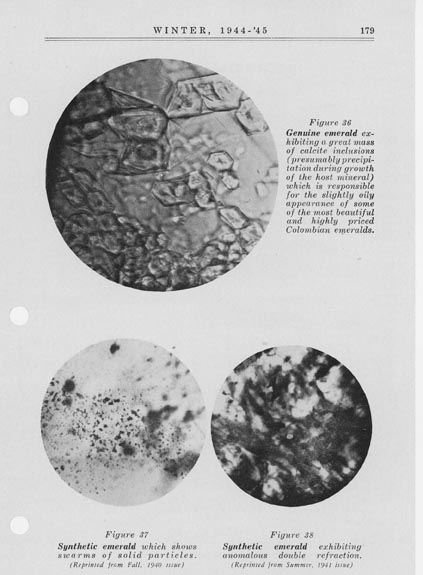 |
[ Fig. 5 ] Although Dr. Gübelin did not specifically use the expression gota de aceite, his caption refers to the “oily appearance” of an emerald he documented in the 1940s. This is comparable to the roiled appearance (like water in cognac) of a hessonite garnet. Dr. Gübelin recognized that this effect occurs in some of the finest emeralds. |
The 2.77-carat emerald pictured below is a wonderful example of this phenomenon. It was highly prized and sold to a collector for $8,000 per carat nine years ago. In this face-up view, the softening is especially visible through the table, where there is internal reflection of the pavilion facets.
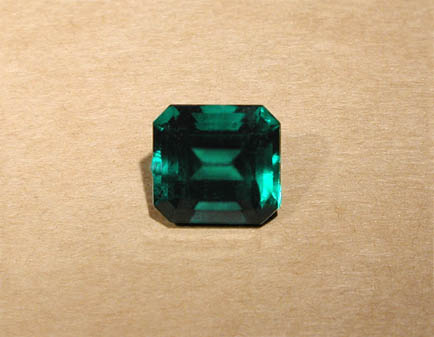 |
[Fig. 6] |
Part of the charm of gota de aceite happens when the stone is moving in your hand, which is impossible to show in a photograph. Moving the emerald reveals how this effect reduces extinction by spreading the areas of internal reflection.
Gota de Aceite: Use and
Misuse of the Term
Confusion of nomenclature with regard to gota de aceite has taken two forms. Because the phrase is typically used only with respect to very fine emeralds, some exceptional stones are labeled with this term even though they do not actually have the effect. The mere fact that the emerald is very fine often inspires the owner or seller of the stone to use gota de aceite as a superlative.
There is also confusion relating to “old mine” emeralds. Old mine is a separate term attributed to rare and fine emeralds, but it refers to the provenance and age of the emerald, specifically those emeralds sent by the Spanish colonies in the New World to Europe and Asia in the sixteenth through eighteenth centuries, along with Swat Valley and Habachtal emeralds of the same era. However, the presence of gota de aceite may wrongly inspire the owner or seller to call the stone “old mine.”
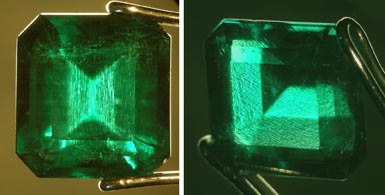 |
[ Fig.7 ] Sometimes the gota de aceite effect can only be found by first looking through the pavilion, especially if it is a muted example. In the case of this 3.65 ct. emerald, the effect was visible through the table. Turning the emerald under magnification and varied lighting will reveal its extent. |
Conversations with Colombian emerald dealers and connoisseurs reveal common agreement that the traditional definition of gota de aceite requires the presence of growth structures, either angular or hexagonal, as seen in figures 2 and 3. By definition, the structures causing the effect must be transparent. Because of variances in the size of the hexagonal structures and in the thickness of the zone containing them, the strength of the effect is also quite variable. I recommend that gemologists classify gota de aceite as either “muted,” “moderate,” or “distinct.” To be considered “distinct,” the effect should be clearly visible to the naked eye as the stone is rocked back and forth. Moving the stone is important to revealing the liquid-like softening of the texture that is the hallmark of gota de aceite. In searching for the effect with a loupe or microscope, it is also important to turn the emerald in all directions as in Figure 7.
The Bengali Interpretation
There is a Bengali word, snigdha, that translates as “smooth” or “tender.” Indians have heard that word used in describing certain emeralds, those with the gota de aceite texture. The same word in Sanskrit, according to gem dealer Jaideep Muckerjee, can mean glistening, moist or softhearted: all good descriptors for emeralds with this effect.
A Perfect Storm of Unique Traits
In addition to the butterfly wing effect, Colombian emeralds are blessed with a natural fluorescence that takes in visible light and sends it back to you as a red message of passion underneath the sober and respectable green color. The red is invisible, but it subconsciously grabs your attention: rather like the way a woman who may be dressed in a normal manner is found wearing perfume of the most primal and powerful scent. The man didn’t see anything, but whatever it was, he now finds this person irresistible. The butterfly wing effect is like adding romantic music to the above scene of enchantment and allure. Can anyone resist?
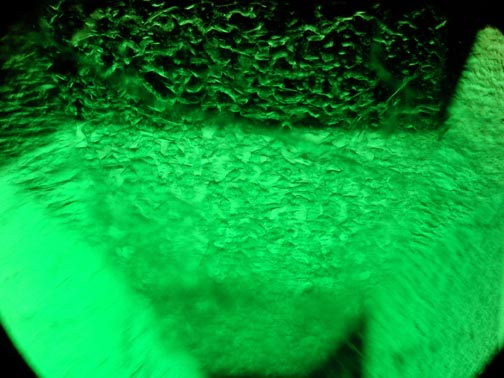 |
| [Fig 8 ] A 3.65 carat square emerald... |
Now that we are in the depths of colored stones enchantment, this is a good time to refer back to the writing of passionate ruby expert Richard Hughes. The reason that ruby from Burma (now Myanmar) and emerald from Colombia are at the absolute top of colored stone desirability and price is that they both share properties like the ones mentioned above in remarkably similar manners. Colombian emeralds have not only fine color but natural fluorescence and microscopic inclusions whose presence reduces extinction. The Burmese ruby fluoresces too, and has inclusions, called silk, that spread the areas of color without reducing transparency. Hughes explains the phenomenon:
For the Richard Hughes quote, a discussion of other textures, the pseudo butterfly effect and conclusion, please go to GIA Gems & Gemology Archives, 'Gota de Aceite' article Fall 2008, or purchase Emeralds A Passionate Guide below.